

Last Tuesday, Sarah in Murrieta discovered a small pile of what looked like sawdust near her baseboard, only to find that $12,500 in structural damage was already hidden behind the drywall. It's a nightmare scenario that keeps many Southern California families awake at night. You likely worry that every winged insect near your window is a sign of an expensive infestation. When you search for termite control near me, you aren't looking for a cold, corporate franchise with a script. You want a local expert who understands the specific pressure termites put on homes in Temecula and North San Diego County.
We agree that your home is your biggest investment and shouldn't be a snack for pests. This guide will help you identify the clear signs of an infestation, explain the difference between flying ants and termites, and outline the most effective treatment options for 2026. You will learn how to secure a termite-free guarantee without the stress of hidden fees. We are diving into the best ways to protect your property and give you the peace of mind you deserve from a neighbor who actually cares about our community.
Key Takeaways
- Understand why recent Southern California weather shifts have triggered a surge in termite activity across Temecula and Murrieta this year.
- Identify the unique nesting habits of Drywood and Subterranean termites to stop them from damaging your home's foundation or attic.
- Avoid the common DIY mistakes that leave your property vulnerable and learn how to secure professional termite control near me for lasting peace of mind.
- Master our 5-point inspection checklist designed specifically for Inland Empire and North San Diego County architectural styles.
- Discover why a neighborly, local approach provides better protection for your family than generic, national pest control chains.
Understanding Termite Threats in the Temecula Valley & North San Diego
Termites aren't just a nuisance; they're officially classified as Wood-Destroying Organisms (WDO). These pests thrive in our specific Mediterranean climate, where mild winters and warm summers provide a year-round breeding ground. In 2026, we're seeing a 15% increase in local activity compared to previous years. This spike is a direct result of the heavy rainfall cycles we saw in 2024 and 2025, which left the soil deep beneath our foundations perfectly hydrated for subterranean colonies to expand. Searching for termite control near me is the first step in defending your largest investment from these hidden invaders.
As your local Bug Guy, I've spent years walking through crawlspaces in Old Town Temecula and inspecting ranch homes in De Luz. I see my job as protecting our community landmarks and the neighborhoods where we raise our families. Termites don't discriminate between a historic building and a new build in French Valley. They only see a food source. We take a handshake approach to business, meaning we treat your home like it's our own mother's house.
Why Our Local Climate Accelerates Infestations
Our geography plays a huge role in how termites behave. In Menifee and Murrieta, the intense summer heat often triggers massive swarming events. When temperatures hit 90 degrees after a light rain, drywood termites take flight to start new colonies in your attic. Meanwhile, the coastal moisture in Oceanside and Carlsbad creates a different problem. The consistent humidity allows subterranean termites to build mud tubes higher up on foundations than they would in drier areas. Inland Empire homes face the highest risk during the transition months of March and October, when the ground temperature sits right at the 70-degree sweet spot for termite movement.
The Real Cost of Ignoring Termite Signs
Waiting to treat an infestation is a gamble you won't win. Most homeowners insurance policies specifically exclude termite damage, leaving you with the full bill. Consider these 2026 cost projections for Southern California:
- Preventative Maintenance: Usually costs between $300 and $600 annually to keep a protective barrier active.
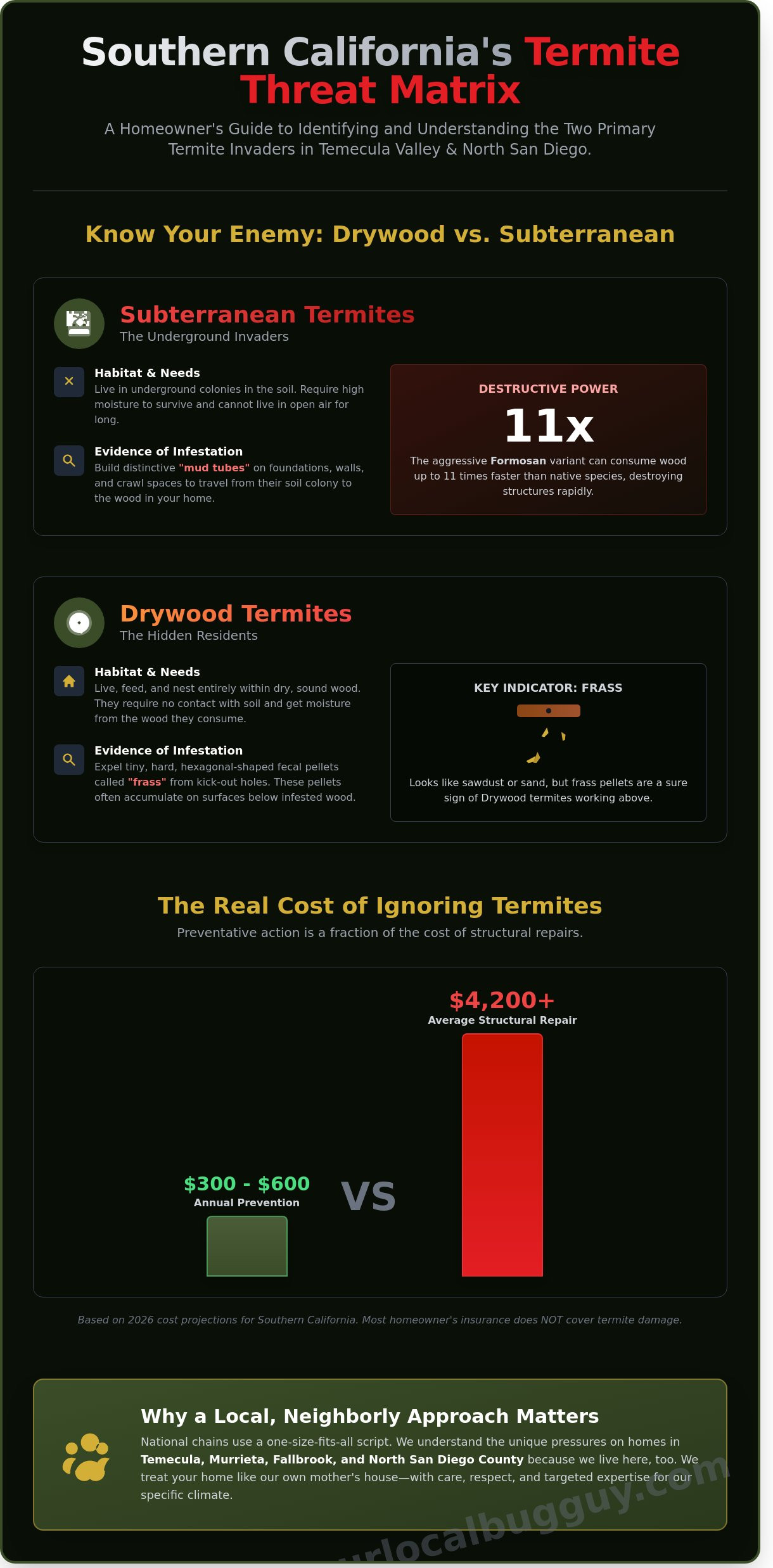
- Structural Repairs: The average cost to replace damaged floor joists or support beams in Temecula currently averages $4,200 per occurrence.
- Home Resale Value: A "Section 1" finding on a termite report can stall a home sale or force a seller to credit the buyer thousands of dollars at the closing table.
Termites are the silent destroyers of the housing market; in 2026 alone, they're projected to cause over $6.2 billion in property damage across the United States. Don't let your home become part of that statistic. Finding reliable termite control near me ensures you catch the problem before the structural integrity of your home is compromised.
Drywood vs. Subterranean Termites: Know Your Enemy
Southern California is a beautiful place to live, but it is also a hotspot for termite activity. From the groves in Fallbrook to the busy neighborhoods of Escondido, homeowners face two primary threats. These pests are not all the same. They live differently, eat differently, and require unique strategies to stop them. Knowing which one is eating your equity is the first step toward reclaiming your peace of mind.
The main difference lies in where they call home. Subterranean termites live in the soil, while Drywood termites live entirely inside your timber. Because their habits differ so much, a "one size fits all" approach won't work. This is why searching for termite control near me and getting a professional eye on the property is vital. A free inspection is the only reliable way to identify the species before repair costs soar. In 2024, the average cost of termite repairs for Southern California homeowners hit $3,200, so catching them early is a big win for your wallet.
Subterranean Termites: The Underground Invaders
These pests are the most destructive group in our region. They require high moisture levels to survive, so they stay underground and build mud tubes to travel safely. In Murrieta, we frequently find these tubes climbing up slab foundations. They crawl through expansion joints or cracks as thin as 1/32nd of an inch to reach your floor joists. You should be especially wary of Formosan termites. This aggressive subterranean variant can consume 12 ounces of wood a day in a mature colony, which is roughly 11 times faster than native species.
Drywood Termites: The Hidden Residents
Drywood termites don't need soil contact. They fly into your home and set up shop in attic vents, eaves, or window frames. We see this often in Temecula homes, particularly those built 25 or 30 years ago. You'll know they're there if you find "kick-out holes." These are tiny exits where termites push out frass, or fecal pellets, that look like small mounds of sand or pepper. When we find these, we help you decide between localized treatment or fumigation. While spot treatments can work for 80% of early detections, a full tenting is the only way to guarantee 100% elimination in a heavily infested structure.
Common Misconceptions: Why DIY Termite Control Often Fails
Many homeowners head to the local hardware store to grab a $20 can of spray the moment they see a bug. It feels like a quick win. Unfortunately, these over-the-counter products rarely solve the actual problem. Most DIY sprays are repellents. They kill the 3% to 5% of termites crawling on the surface but leave the rest of the colony untouched. This creates a "tip of the iceberg" scenario where the real damage continues out of sight inside your structural beams.
Professional termite control near me is different because it addresses the biology of the pest. When you spray a repellent, you might actually trigger a survival mechanism called budding. The termites sense the danger and split the main colony into multiple satellite colonies. Instead of one problem area, you now have three or four groups eating your home from the inside out. Professional-grade, non-repellent liquids work differently. Termites can't detect them, so they carry the treatment back to the queen. This neutralizes the entire population at the source rather than just moving them around.
The "Flying Ant" Confusion
Identifying the enemy is the first step toward protection. In Menifee and across the Inland Empire, homeowners often mistake termite swarmers for common ants. Use these three markers to tell the difference:
- Waist: Termites have a thick, straight waist. Ants have a pinched, narrow waist.
- Antennae: Termite antennae are straight and look like tiny beads. Ant antennae are elbowed or bent.
- Wings: Termites have four wings of equal length. Ants have two long wings and two short wings.
Seeing discarded wings on a windowsill is a major red flag. Don't waste time guessing. Snap a photo. Send it over to your local bug guy for a fast, honest ID. Getting the right answer early can save you thousands in repair costs later this year.
Is Professional Treatment Safe for My Family?
We live in these neighborhoods too. We understand that the safety of your kids and pets is your biggest concern. Modern pest control has moved far away from the "spray everything" approach used in the 1990s. Today, we use targeted, EPA-approved products that are designed to be low-impact and highly effective. Our technicians apply these solutions specifically to the areas where termites travel, such as foundation cracks or wall voids. This precision keeps your family safe while effectively removing the threat. You can check out our client service plans to learn more about our commitment to eco-conscious, neighborly service that protects your Southern California home without the worry.
5 Critical Termite Warning Signs for Southern California Homeowners
Grab a cup of coffee and take 20 minutes this Saturday to walk around your property. Protecting your Inland Empire home starts with your own two eyes. Our local architecture, especially slab-on-grade homes with stucco finishes, offers specific hiding spots for pests. You don't need to be an expert to spot trouble, but you do need to be consistent. Even if your home looks perfect, 2026 industry data shows that an annual professional inspection is the only way to catch colonies before they cause thousands in structural damage. Searching for termite control near me is the first step, but these signs tell you it's time to call the Bug Guy immediately.
Exterior Inspection Points: Stucco and Soil
Start your walk at the foundation. Look for mud tubes, which are pencil-thin tunnels about 1/4 inch wide, climbing up your concrete. These act as protected highways for subterranean termites, especially near leaky irrigation heads. Check every backyard deck or patio cover for wood-to-soil contact. If your wooden posts sit directly in the dirt, you've built a bridge for an infestation. Finally, clear any debris away from your "weep screed." This metal strip at the bottom of your stucco must remain visible to prevent termites from slipping behind the wall unnoticed.
Interior Red Flags: Attic and Baseboards
Inside the home, look for bubbling or peeling paint that looks like minor water damage. This often means termites are eating the paper backing of your drywall. Use a flathead screwdriver to gently tap your baseboards and window frames. If the wood sounds hollow or the tool easily punctures the surface, termites have likely hollowed out the interior. Shine a bright flashlight across your attic rafters and look for small, pepper-like granules known as frass that indicate a drywood termite presence.
Don't ignore your shared fence lines. Termites don't care about property boundaries, and a colony in your neighbor's yard can reach your house in less than 48 hours. If you see wings on a neighbor's porch, it's time to act. Being proactive keeps the whole block safe and gives you lasting peace of mind.
If you've spotted any of these red flags, don't wait for the damage to get worse. Reach out to Your Local Bug Guy for reliable termite control near me and protect your family's biggest investment today.
Choosing Your Local Bug Guy for Expert Termite Protection
When you search for termite control near me, you aren't just looking for a technician; you're looking for a neighbor you can trust. Big national chains often treat your home like a number on a spreadsheet. At Source Pest Control, we take a different approach. We've spent over 20 years protecting families across Riverside and San Diego counties. This isn't just a service area to us; it's our backyard. Our business model relies on a neighborly handshake and a 100 percent satisfaction guarantee. If the bugs come back, so do we. It's that simple.
Experience matters when dealing with Southern California's unique environmental pressures. Since 2004, our team has identified the specific movement patterns of local termite colonies. We don't guess; we know exactly where these pests hide in local home builds. Scheduling your protection is easy and stress-free. Our process includes:
- A free, no-obligation termite inspection of your entire property.
- A clear, jargon-free explanation of any active threats we find.
- A customized treatment plan tailored to your home's specific structure.
- Transparent pricing with no hidden "corporate" fees.
Personalized Service Plans for Every Home
Every home faces different risks. We offer Monthly, Bi-Monthly, and Quarterly service options to ensure your peace of mind stays intact year-round. These plans integrate termite protection into a total pest management strategy, keeping ants, spiders, and rodents away simultaneously. For full details on our competitive rates, visit our page on Termite Inspection and Remediation Fees. We believe in total transparency because that is how you treat a neighbor.
Take Action: Secure Your Home Today
Don't wait for a small problem to become a structural nightmare. Homeowners in Temecula, Murrieta, and the surrounding valleys deserve a protector who is locally owned and operated. Our team takes immense pride in being the "Bug Guy" you can call whenever you're worried about your home's safety. We provide the most reliable termite control near me by combining technical expertise with a can-do attitude. Your home is likely your biggest investment; let's keep it safe together. Schedule your free termite inspection with Your Local Bug Guy today!
Take Control of Your Home’s Future
Termites don't take breaks, and neither should your home defense strategy. We've explored how Southern California homeowners face unique threats from both drywood and subterranean species. Waiting for visible damage usually means expensive repairs are already necessary. Since DIY methods fail to reach the heart of the colony, professional intervention is the only way to ensure your property remains standing strong in 2026. You deserve the peace of mind that comes from working with a neighbor who knows the Temecula Valley landscape inside and out. With over 20 years of local experience, our team uses family-safe, EPA-approved treatments that keep your kids and pets safe while eliminating pests. Finding reliable termite control near me shouldn't be a stressful chore. We back every job with a 100% satisfaction guarantee to ensure you're completely happy with the results. Let's get those pests out of your walls so you can focus on what matters most. Our friendly team is ready to help you reclaim your space today.
Protect your home from the silent destroyer; get a free inspection from Your Local Bug Guy!
Frequently Asked Questions
How much does termite treatment cost in Temecula?
Termite treatment in Temecula typically costs between $500 for localized spot treatments and $3,500 for full-home fumigation. Most homeowners in the 92591 zip code pay an average of $1,200 for a standard 2,000 square foot property. Prices vary based on the size of your home and the specific type of termite found. Call your local bug guy for a free inspection to get an exact quote for your property.
Can I stay in my house during a termite treatment?
You can stay inside for localized liquid or foam treatments, but you must vacate for 48 to 72 hours during a full-house fumigation. If we use localized termiticides or orange oil, your family can remain in the home while we work. For tenting, California law requires all residents, pets, and plants to leave the premises. We provide a 10-point checklist to help you prepare your home for a safe and easy return.
How often should I get a termite inspection in Southern California?
You should schedule a professional termite inspection every 12 to 24 months to protect your Southern California home. Drywood termites stay active year-round in our warm climate, so annual checks are the best way to catch infestations before they cause structural damage. Finding reliable termite control near me before you see wings or wood dust saves homeowners an average of $2,500 in major repair costs. Regular maintenance keeps your property secure.
Is a termite inspection required to sell my home in Murrieta?
California law doesn't mandate a termite inspection to sell a home, but 95% of lenders and buyers in Murrieta require a Wood Destroying Pest Inspection report. Most local real estate contracts include a request for a Section 1 clearance before the deal closes. Providing a clear report from 2025 or 2026 shows buyers you've maintained the property well. This simple step prevents expensive delays during your 30-day escrow period.
What is the difference between a termite bond and a service plan?
A termite bond is a formal contract that acts like an insurance policy, while a service plan focuses on routine preventative maintenance. Bonds often include a $5,000 to $10,000 damage repair guarantee if termites return after treatment. Service plans usually involve quarterly or bi-annual visits to refresh your perimeter barriers. Both options provide peace of mind for homeowners looking for termite control near me to protect their biggest investment from local pests.
Will termites go away on their own if I remove the infested wood?
Termites won't leave your property just because you replaced a few infested boards or beams. A single subterranean colony can house 60,000 to 2 million termites living deep in the soil or behind your drywall. Removing the wood only takes away their current food source, not the colony itself. You need a professional treatment to eliminate the queen and stop the colony from simply moving to another part of your house.
Are the chemicals used for termite control safe for my dogs?
Our termite treatments are safe for your dogs and other pets once the application has completely dried, which usually takes 2 to 4 hours. Your local bug guy uses modern products like Altriset that specifically target termite muscles without harming mammals or helpful honeybees. We prioritize your family's safety and follow strict application guidelines. Just keep your pups in a separate area or inside while we apply the protective barrier around your home.
What happens if termites return after a professional treatment?
If termites return within your warranty period, we provide a full re-treatment at no extra cost to you. Most of our professional services include a 1-year or 2-year renewable guarantee to ensure your home stays protected long-term. We respond to warranty calls within 24 to 48 hours to address any new activity immediately. This commitment to quality is why your neighbors trust us to keep their properties pest-free year after year.