

What if the wood damage in your home isn't from termites eating your walls, but from ants hollowing them out for a remodel you never authorized? It sounds like a small distinction, but it's the difference between a total loss and a targeted fix. Finding a pile of sawdust near your baseboards often triggers a sudden fear of hidden structural collapse. You want to protect your family and your investment without overpaying for repairs you don't actually need. This guide simplifies carpenter ant damage repair Fallbrook homeowners can rely on by showing you exactly how to spot the difference between an ant gallery and a termite tunnel.
You deserve peace of mind and a clear plan of action to restore your property. I'll help you assess the damage and decide when to use a simple wood filler versus when it's time for a full structural replacement under the March 2026 San Diego County building codes. We'll also look at why professional treatment in North County typically costs between $200 and $450 as of April 2026. This article provides a step-by-step framework to stop the moisture issues that attract these pests and find a local expert who handles both the infestation and the aftermath.
Key Takeaways
- Learn to spot the difference between smooth ant galleries and messy termite damage by looking for tell-tale "frass" piles.
- Use the simple "Screwdriver Test" to check wood density and decide if you're dealing with a cosmetic fix or a structural emergency.
- Understand why you must eliminate the entire colony and stop moisture leaks before beginning your carpenter ant damage repair Fallbrook restoration.
- Identify the specific construction flaws in local homes that invite these pests to nest in your walls.
- Get a clear framework for following the latest 2026 building codes when replacing damaged load-bearing beams.
Identifying Carpenter Ant Damage in Fallbrook Homes
Fallbrook homeowners love our lush landscape, but those towering oak trees and dense brush provide a perfect staging ground for pests. The Carpenter ant doesn't eat wood like a termite does. Instead, it acts as a tiny, uninvited contractor, hollowing out your home's structural timber to build nests. This distinction is vital because it changes how we approach carpenter ant damage repair Fallbrook projects. You aren't just filling holes; you're often restoring the integrity of a "mined" beam. Because these ants prefer wood that's already softened by moisture, our local weather cycles play a huge role in infestations. Our wet winters often lead to minor roof leaks or window seal failures, creating the perfect damp environment for ants to start their work. When the dry Santa Ana winds hit, the ants move deeper into these cool, damp galleries, accelerating the hollowing process while you might not even notice they're there.
The most reliable sign of an active colony is the presence of frass. Frass is a mixture of wood shavings, dead insect parts, and even bits of fiberglass insulation that the ants kick out of their tunnels as they expand. Unlike the gritty, mud-filled tubes left by termites, ant frass looks like a clean pile of sawdust. If you find a small mound of wood shavings tucked into a corner or under a baseboard, don't just sweep it away. It's the primary evidence of an active colony working inside your walls.
The Appearance of Ant Galleries
Ant galleries look remarkably clean and professional. Imagine someone took a piece of sandpaper to the inside of a wood beam and smoothed it out until it felt like finished furniture. That is the work of a carpenter ant. They follow the grain of the wood, but they're selective. They excavate the softer wood and leave the harder, more durable grain intact. This creates a series of smooth, hollowed-out tubes that can significantly weaken a load-bearing stud over time. Termites leave behind a mess of soil and excrement; carpenter ants leave a polished, empty void.
Where to Look in Your Fallbrook Property
Start your inspection in areas where moisture naturally collects. In many North County homes, this means checking under the kitchen sink, around the base of sliding glass doors, and in the subflooring of ranch-style houses. Check your wooden decks and patio covers, especially where the wood meets the soil. This wood-to-soil contact acts as a direct highway for ants to enter your home. Since Fallbrook has a high concentration of older oak trees, check any branches that overhand your roofline. These act as bridges, allowing ants to bypass your foundation and enter through the attic or eaves. If you see ants trailing along a fence line or a branch toward your house, follow them to find the entry point.
Carpenter Ants vs. Termites: Why the Repair Approach Differs
Understanding the difference between these two pests saves you money and stress. Termites are like hungry teenagers at a buffet; they consume the wood for nutrition. Carpenter ants are like meticulous carpenters; they only excavate the wood to create living space. This fundamental difference means your approach to carpenter ant damage repair Fallbrook homes need is often much more surgical. While termites might destroy an entire floor joist from the inside out, ants usually stick to a specific damp area where the wood is softest. Because they don't eat the wood, the structural integrity often remains higher in the early stages compared to a termite infestation.
Repairing ant damage always starts with the "why." Ants rarely attack dry, healthy wood. They look for a leak. Whether it's a faulty window flashing or a slow drip from a pipe, that moisture is the invitation. If you fix the wood but ignore the leak, the ants will be back in six months. Termite repair is more about structural reinforcement because their damage is systemic. Ant repair is about moisture management and targeted restoration. If you're unsure which pest is currently "renovating" your home, ask a neighborly expert to identify the culprit before you start cutting into your walls.
Mud Tubes vs. Clean Voids
Termites build mud tubes to stay hydrated and protected. These tubes leave behind a gritty, soil-like mess that compromises the wood's inner structure and makes it difficult for fillers to bond. Carpenter ants do the opposite. They keep their tunnels spotless. This "clean void" makes it easier to use high-quality epoxy resins or wood fillers to restore structural strength. However, if the damage is widespread or you find mud instead of sawdust, the protocol for termite control near me is a different beast entirely. You can't just patch termite damage; you often have to "sister" the beam with new lumber to ensure the home remains safe.
Speed of Destruction
Don't let their small size fool you. Ants move slower than termites, but Fallbrook’s Mediterranean climate allows them to work year-round. According to the UC Statewide IPM Program, colonies can remain active through our mild winters. This means a small problem in the spring can become a structural headache by the following year. Waiting to see if the problem goes away only drives up your eventual repair bill. In North County, a few seasons of activity can turn a solid window header into a hollowed-out shell that sags under the weight of your roof.
Assessing the Damage: When to Repair vs. When to Replace
Grab a flathead screwdriver and a high-powered flashlight. This "Screwdriver Test" is the most effective way to start your assessment. Press the tip of the screwdriver into the wood where you suspect an infestation. If the metal sinks in easily or the wood feels spongy, the internal structure is compromised. In a healthy beam, the screwdriver should barely leave a mark. This simple check helps you determine the scope of your carpenter ant damage repair Fallbrook project before you call in a contractor. You need to know if you're looking at a weekend DIY patch or a major structural overhaul that requires a permit under the March 2026 San Diego County building codes.
The biggest factor in your decision is the wood's load-bearing status. A damaged window sill is a cosmetic headache, but a hollowed-out header over a sliding glass door is a safety hazard. If the wood supports the weight of your roof or second floor, the margin for error is zero. You must also account for secondary rot. Carpenter ants love damp wood, and that moisture often invites wood-decay fungi. This fungus eats the lignin in the wood fibers, leaving it brittle and prone to sudden failure. While the ants create the voids, the rot often finishes the job, making the wood unsalvageable even if the colony is gone.
The Structural Integrity Check
Follow the 25% rule for all weight-bearing timber. If more than a quarter of the beam's total volume is hollowed out or rotted, a replacement is usually the only safe option. In the classic ranch-style architecture common across Fallbrook, pay close attention to the 4x4 posts on your porch and the main horizontal headers. These are critical load points. For major damage to your foundation sill plates or primary supports, it is best to consult a structural engineer. They can provide a stamped plan that satisfies the Structural Pest Control Board requirements and ensures your home remains earthquake-safe.
Cosmetic vs. Structural Repairs
For non-structural trim, siding, or decorative molding, high-performance wood epoxies work wonders. These two-part resins fill the clean galleries left by ants and bond tightly to the remaining wood fibers. If the wood is only slightly softened, you can use a wood consolidant. This liquid plastic soaks into the grain and hardens as it dries, "petrifying" the wood to prevent further crumbling. Keep in mind that pest control in Temecula CA follows these same structural standards. Whether you're in Fallbrook or just over the hill, the goal is always the same: restore the strength first, then worry about the paint.
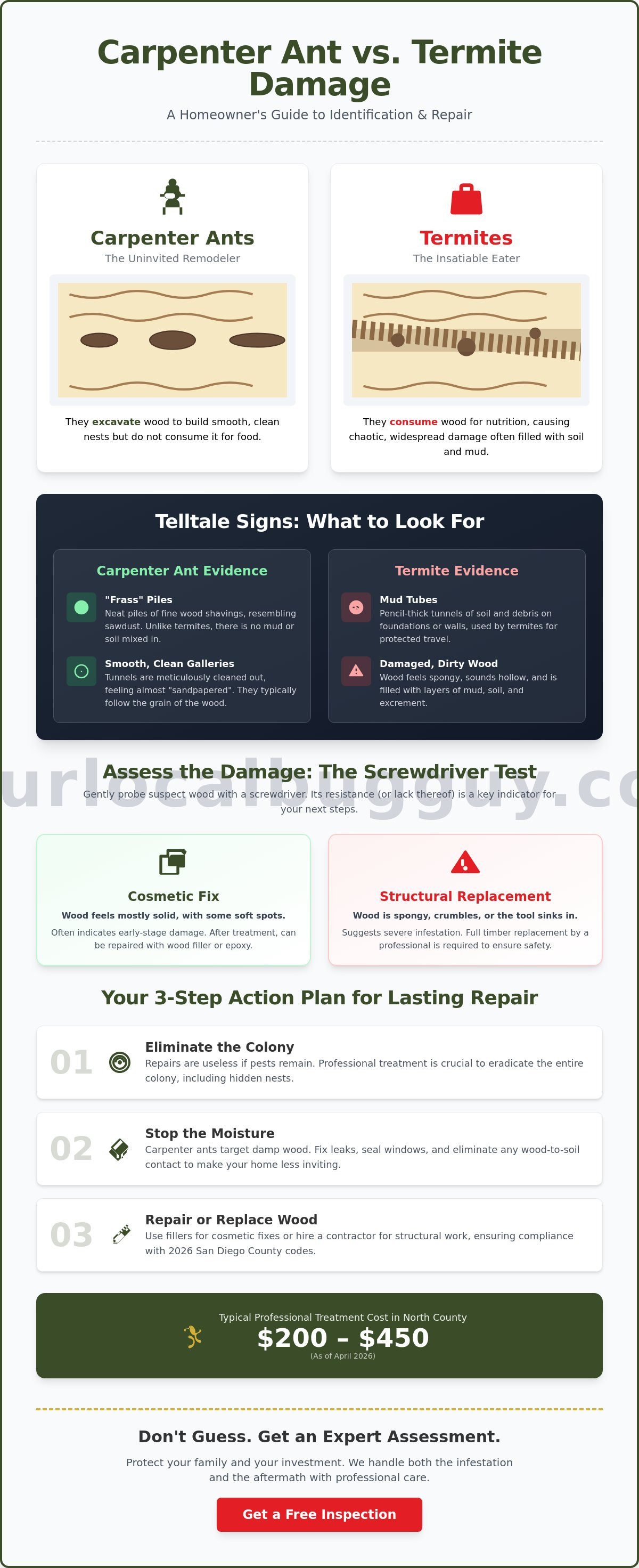
The Step-by-Step Process for Carpenter Ant Damage Repair
Restoring your home requires a specific order of operations. If you rush to patch a hole while the ants are still inside, you're just sealing in a problem that will eventually eat its way back out. Successful carpenter ant damage repair Fallbrook projects follow a five-step path to ensure the fix lasts as long as your mortgage. You start by killing the colony, then you remove the invitation (moisture), and finally, you rebuild the structure. Skipping any of these steps is a recipe for a repeat infestation within 12 months. It's about doing the job right the first time so you can sleep soundly again.
Once the area is dry and pest-free, cut away the soft, decayed wood. You must reach "sound" timber where the wood is still dense and light in color. After removing the rot, apply a borate treatment. Borates, often using active ingredients like borax or disodium octaborate tetrahydrate, act as a long-term fungicide and insecticide. This creates a chemical barrier that stops future fungal growth. For the final step, you'll either reinforce the beam with new lumber or use a high-quality epoxy to fill the voids. If you need help identifying the extent of the damage before you start cutting, schedule a professional inspection today.
Why Extermination Must Come First
Never repair wood while you still see "scouts" wandering around. If you block their main exit with wood filler, the colony often panics and "buds." This means they split into several smaller satellite nests deeper inside your walls, making the infestation much harder to track. Hardware store sprays often just repel the ants, pushing them into new areas of your home. Professional-grade baits are far more effective because the ants carry the slow-acting poison back to the queen. It's best to let a bug company near me handle the elimination phase to ensure the entire network is gone before you pick up a hammer.
Moisture Remediation in Fallbrook
Fallbrook homes face unique moisture challenges. Our heavy morning mist can keep siding damp, and over-active irrigation systems often blast water directly against the foundation. Check your gutters for clogs; a single blocked downspout can dump gallons of water into your eaves during a spring rain. Use a moisture meter to verify the wood's moisture content is below 15% before applying any fillers or paint. When you install new wood, remember to "back-prime" it. This means painting all six sides of the board, including the ends, to seal out moisture before you nail it into place. This simple step prevents the edges from soaking up water and inviting a new generation of ants.
Why Fallbrook Expertise Matters for Long-Term Protection
Choosing a team that understands the specific microclimates of North County makes a massive difference in the durability of your home. Fallbrook isn't just another stop on a corporate route; it's a unique environment where the Mediterranean climate dictates pest behavior. Source Pest Control knows the subtle differences between Camponotus modoc, which thrives in the damp wood of our misty mornings, and Camponotus vicinus, which is more resilient during our dry Santa Ana winds. This specialized knowledge ensures your carpenter ant damage repair Fallbrook plan accounts for the exact species hollowing out your home. We don't just look for bugs; we look for the construction flaws common in local ranch-style homes and older avocado grove estates that invite these colonies inside.
Our wet winters and scorching summers create a rapid cycle of wood expansion and contraction. This movement often opens up tiny cracks in your home's exterior seal, providing a direct path for ants to reach softened, water-damaged timber. Because we live and work in this community, we understand how to navigate the March 2026 San Diego County building code updates during your restoration. Source Pest Control offers a "handshake" style of business that you won't find with a massive national franchise. You aren't just a ticket number to us; you're a neighbor whose home we are proud to protect.
The Local Advantage
Big corporations often rely on "one-size-fits-all" chemical applications that might not be the best fit for our local ecosystem. Source Pest Control prioritizes family-safe, EPA-approved products that target the infestation without putting your pets or children at risk. We focus on the source of the problem, not just the symptoms, ensuring the ants don't return to finish what they started. By choosing a local specialist over a national chain, you get a technician who knows the specific pest pressures of your neighborhood and provides a more personalized, thorough treatment plan.
Protecting Your Investment
The best way to handle structural damage is to prevent it from happening in the first place. As of March 2026, recurring monthly service plans in California average between $40 and $65, which is a small price to pay to avoid a multi-thousand dollar structural repair bill later. Our bi-monthly and quarterly inspection plans catch scouts before they can establish a satellite nest in your walls. Source Pest Control stands behind every job with a 100% satisfaction guarantee and provides free re-treatments if the pests ever show their faces between scheduled visits. Don't wait for your floorboards to feel soft. Contact Your Local Bug Guy for a Free Inspection today!
Secure Your Home Against Silent Excavators
You now have the tools to tell the difference between a simple cosmetic fix and a structural emergency. Remember to look for clean, polished galleries and those tell-tale piles of sawdust known as frass. Successful carpenter ant damage repair Fallbrook homeowners can trust depends on stopping the moisture first. If you don't fix the leak, the ants will return to the same soft wood every single time. By following the five-step restoration process, you protect your family and your property value from long-term decay.
Your Local Bug Guy brings 20+ years of local experience to every driveway in North County. We use family-safe, EPA-approved products to ensure your home stays a sanctuary for your loved ones, not a habitat for pests. Our 100% satisfaction guarantee means we provide free re-treatments until the job is done right. Don't let a small hollowing become a major collapse. Protect your Fallbrook home from carpenter ants; Schedule a Free Inspection today! We are here to help you get back to enjoying the peace of mind you deserve.
Frequently Asked Questions
Can I just use wood filler to fix carpenter ant damage?
You can only use wood filler for cosmetic repairs on non-load-bearing trim or siding. If the damage affects the structural integrity of your home, wood filler won't provide the strength needed to support the weight of your roof or walls. Always use the screwdriver test to check for soft spots before deciding. For deep voids in weight-bearing beams, you must replace the timber to meet the March 2026 building codes.
How much does it cost to repair carpenter ant damage in Fallbrook?
Professional treatment costs for a one-time residential visit in San Diego County range from $200 to $450 as of April 2026. This price covers the specialized inspection and void injections needed to reach the queen. The actual carpenter ant damage repair Fallbrook homeowners face depends on current lumber prices and the extent of the wood rot. Catching the problem early prevents these costs from doubling over a single season.
Do carpenter ants ever go away on their own?
Carpenter ants won't leave your property on their own as long as there is a moisture source and wood to excavate. Unlike some seasonal pests, these colonies are persistent and will continue to grow as long as they have access to water. In Fallbrook's mild climate, colonies remain active through the winter. If you don't intervene, the satellite nests will eventually spread to other parts of your house.
Is carpenter ant damage covered by my Fallbrook homeowners insurance?
Most homeowners insurance policies in Fallbrook don't cover damage caused by carpenter ants or other wood-destroying organisms. Carriers typically view pest infestations as a maintenance issue that's the responsibility of the owner. Since the damage happens over several months or years, it doesn't qualify as a sudden and accidental loss. Review your specific policy from 2025 or 2026 to confirm your coverage limits.
How can I tell the difference between ant frass and regular sawdust?
Look for insect parts and bits of insulation mixed in with the wood shavings to identify ant frass. Regular sawdust from a home project is clean and uniform. Frass looks like a messy pile of trash because the ants are cleaning their galleries as they expand. You might also see dead ants or discarded wings in the pile. This indicates an active infestation rather than just old wood dust.
What happens if I ignore the carpenter ant damage?
Ignoring the damage leads to sagging window headers, warped door frames, and eventual structural failure. What starts as a targeted treatment can turn into a massive renovation if a load-bearing support collapses. The hollowed-out galleries also act as a sponge for moisture. This invites wood-decay fungi, which rots the remaining wood fibers and makes the damage spread even faster through your home's frame.
Are the treatments safe for my pets and family?
Yes, we use EPA-approved products and application methods designed to be safe for your pets and family. Our technicians focus on crack and crevice treatments and wall void injections. This keeps the products where the bugs live and away from your common living spaces. We prioritize your peace of mind and follow all California safety regulations updated in early 2026 to ensure a healthy home environment.
How long does the repair process typically take?
The total process usually takes between 10 and 21 days from start to finish. You must wait about 7 to 14 days after the initial extermination to ensure the colony is completely dead before sealing the wood. This prevents you from trapping live ants inside your walls. Once the pest activity stops, the actual wood repair or replacement typically takes 1 to 3 days depending on the scope of the work.