

Last Monday, a neighbor in the Temecula Valley discovered a pile of discarded wings on their windowsill and felt that sinking pit in their stomach. They weren't sure if they were looking at harmless ants or a massive termite colony eating through their floor joists. You shouldn't have to spend your nights worrying about invisible structural damage or whether your kids are safe from harsh chemicals. Your home is your biggest investment, and it deserves a protector who understands our unique Southern California climate.
We know you want a pest-free house without the stress of a cold, corporate sales pitch. This guide simplifies termite and pest control so you can identify threats before they become five figure repair bills. You will learn how to spot the difference between swarming pests, keep your pets safe during treatments, and maintain a perimeter that bugs simply won't cross. This 2026 checklist gives you the exact steps to keep your property secure and your mind at ease.
Key Takeaways
- Identify the "hidden" warning signs in your crawlspace and attic before small issues become big headaches for your home.
- Learn how to stop infestations before they start by managing your irrigation and eliminating wood-to-soil contact around your foundation.
- Compare professional barrier and baiting strategies to choose the right termite and pest control plan for your property’s unique layout.
- See why a neighborly, handshake-style business provides more reliable protection for Temecula Valley families than a national corporate franchise.
The Southern California Dual Threat: Why Termite and Pest Control Go Hand-in-Hand
Temecula Valley homeowners face a unique challenge as we move into 2026. Our local climate is changing, and the pests are moving with it. Integrated termite and pest control isn't just a service; it's a holistic shield for your biggest investment. I look at your home as a single ecosystem. If you only treat for ants but ignore the wood-destroying organisms in your crawlspace, you're leaving the back door wide open. A true defense strategy covers everything from the soil to the roofline.
The Inland Empire heat creates a perfect storm for local property owners. When temperatures in Temecula or Murrieta hit 105 degrees in July, pests don't just stay outside. They seek the same things you do: water, shade, and a cool environment. This drives invasive ants and termites into your walls at the same time. Choosing a "wait and see" approach is the most expensive mistake you can make. It's much cheaper to maintain a barrier than it is to replace a load-bearing beam.
I focus on perimeter defense rather than just structural remediation. Structural remediation is what happens after the damage is done. It's reactive and costly. Perimeter defense is about drawing a line in the sand at your property boundary. By stopping the migration of pests before they reach your foundation, we keep your home safe and your repair bills at zero.
The High Cost of Southern California Termites
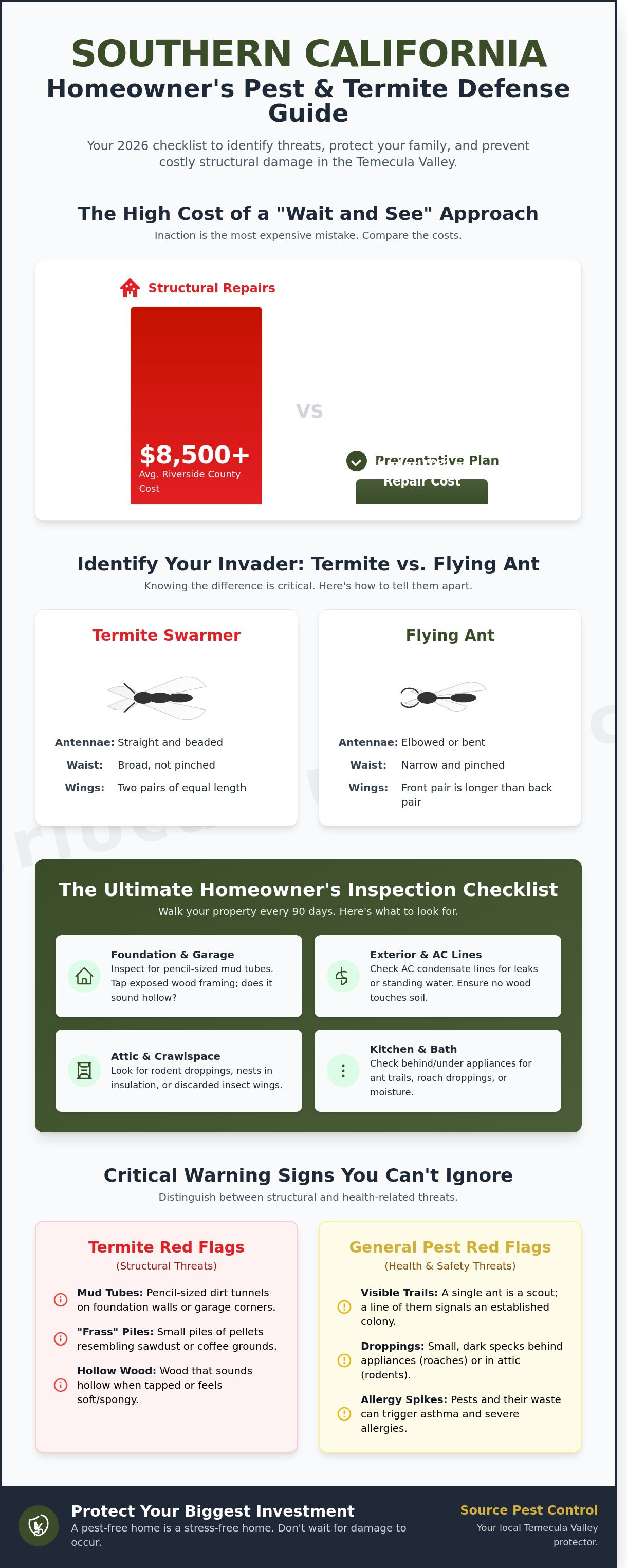
California is one of the few places where homes are hit by both Drywood and Subterranean termites at once. Understanding Termite biology and behavior is the first step in stopping them. In 2025, the average cost for termite-related structural repairs in Riverside County climbed past $8,500 per household. Compare that to the cost of a routine inspection and preventative plan, which is usually less than 10 percent of that figure. Wood-destroying organisms are any living beings, such as termites or wood-decay fungi, that can cause damage to the structural wood of a property as identified during a standard California real estate inspection.
Why General Pests Are More Than Just a Nuisance
Ants, roaches, and spiders are more than just an eyesore. They carry bacteria like E. coli and can trigger severe allergies or asthma in children. In Murrieta neighborhoods, about 70 percent of indoor infestations are linked to heavy outdoor vegetation touching the siding. My "Bug Guy" philosophy is simple: protection starts at the property line. We treat the source, not just the symptom. This keeps your family safe from both the pests and the diseases they carry. It's about providing you with peace of mind and a home that feels like a sanctuary again.
The Ultimate Homeowner’s Inspection Checklist: Signs You Can’t Ignore
Grab a bright flashlight and a flathead screwdriver. You need to walk your property at least once every 90 days to stay ahead of local invaders. Focus your attention on the dark, quiet corners where bugs love to hide. Check your crawlspace, the insulation in your attic, and the dusty gaps behind your kitchen appliances. In the 100-degree Menifee summer heat, pests hunt for water with an intensity that can surprise you. Check your AC condensate lines regularly. A tiny leak provides enough moisture to attract thousands of thirsty pests within 48 hours.
Use this physical checklist during your walk:
- Inspect the foundation for pencil-sized mud tubes every 3 months.
- Check AC condensation lines for standing water or leaks.
- Examine attic insulation for signs of rodent nesting or droppings.
- Look behind the refrigerator and dishwasher for ant trails.
- Perform a "tap test" on all exposed garage framing and baseboards.
Termite Warning Signs (The Structural Red Flags)
Look for mud tubes along your foundation or in the corners of your garage. These look like veins made of dried dirt. They protect subterranean termites from the dry California air as they travel. If you see small piles of what looks like sawdust or coffee grounds, you found frass. This is drywood termite waste. Use your screwdriver for a tap test on exposed beams. If the wood sounds hollow or the tool sinks into the grain, you have a structural issue. For more detailed termite identification and control tips, the EPA provides excellent technical guidelines. Don't confuse termite swarmers with flying ants. Termites have straight antennae and four wings of equal length. Ants have bent antennae and wings of different sizes.
General Pest Warning Signs (The Health Red Flags)
A single ant in your kitchen is rarely just a visitor. It's a scout marking a chemical trail for a colony of 10,000 others to follow. In your garage or shed, look for messy, irregular webs in low corners. These often belong to Black Widows, which remain a common sight across the Temecula Valley. Rodents are another major concern. A single mouse can leave 20 to 30 droppings in one night. Look for these or small chew marks on food packaging in your pantry. If you find these signs, it's time to reach out for professional termite and pest control to keep your family safe. Our team can help you identify exactly what's moving in before the damage gets expensive.
Barrier vs. Bait: Understanding Professional Control Strategies
Choosing the right termite and pest control method for your Temecula home depends on your specific situation. We use two main strategies to keep your property safe. Liquid soil treatments create a continuous chemical zone that stops pests on contact. Baiting systems use stations to lure termites away from your structure and back to their colony. Liquid barriers offer immediate protection. Baiting systems are often preferred for homes where drilling into foundation slabs isn't ideal. Both methods have high success rates when installed by a local expert who knows our soil types.
We prioritize your peace of mind. All products used in North San Diego County are EPA-approved and family-safe. We treat your home like our own. Our team applies these solutions with precision, ensuring they target bugs without putting your pets or kids at risk. We don't just spray and leave; we strategically place products where they do the most work with the least impact on your daily life.
Forget the idea of a "one-time fix." Pests are a year-round threat in the Inland Empire. A single treatment might clear current invaders, but it won't stop the next wave. Regular maintenance every 60 to 90 days is the industry standard for a reason. It ensures your protective barrier remains active as weather and soil conditions change. In 2026, we've seen that consistent service prevents 95 percent of major infestations before they start.
Termite Remediation Techniques
Fumigation is the heavy hitter. We recommend tenting for Murrieta homes when drywood termites have moved deep into the structural timbers where topical sprays can't reach. If we catch them early, localized chemical treatments work wonders. These targeted applications stop small colonies before they spread. For a deeper look at local risks, check out our California termite guide. Understanding different California termite species helps us choose the right tool for the job.
The Perimeter Pest Defense System
Our perimeter defense acts like an invisible shield. We apply a liquid barrier around your foundation to stop ants and spiders before they cross the threshold. This termite and pest control strategy includes "de-webbing" your eaves and "granule application" in your garden beds. These granules reach deep into the mulch where liquid might not penetrate. We know Inland Empire bugs better than anyone. We adjust our chemical selection based on whether we’re fighting invasive Argentine ants or local black widows. This local expertise ensures your home stays a sanctuary for your family.
Preventing Infestations: A Season-by-Season Maintenance Checklist
Effective termite and pest control requires a proactive stance against the unique environment of the Temecula Valley. You don't want to wait until you see a swarm to take action. Follow these four essential steps to harden your home against invaders. First, eliminate all wood-to-soil contact. Subterranean termites use these bridges to enter your structure undetected. Ensure there is at least a 6-inch gap between the soil and your home's siding. Second, manage your irrigation. Misaligned sprinklers create moisture pockets in our local clay soil. Termites are 70% more likely to target foundations with high soil moisture levels. Third, seal every entry point. Use pest-proof materials like stainless steel mesh or copper wool for cracks wider than 1/16th of an inch. Finally, schedule a professional inspection. Catching a problem early saves homeowners an average of $3,200 in structural repairs compared to delayed treatments.
Summer and Spring Surge in Temecula
Spring and summer heatwaves in the Temecula Valley drive ants indoors looking for water. You'll notice trails near sinks and baseboards during the first 90-degree days in May. Termite swarms usually follow our first heavy spring rains, often occurring between February and April when the ground is warm and damp. Keep your landscaping in check by trimming all bushes and ground cover at least 12 inches away from your siding. This removes the pest highway that leads straight to your roofline. Maintaining this clearance allows for better airflow and helps the soil near your slab dry out faster after a storm.
Fall and Winter Rodent Prep
When the temperature drops in Murrieta, rats and mice look for warmth. They often target attics and crawlspaces to escape the winter chill. Check your eaves and roof vents for any openings larger than a quarter; these are prime entry points for roof rats. Use hardware cloth to secure these areas because plastic screening won't stop a determined rodent. For a deeper dive into protecting your home from these furry intruders, read our rodent control guide. It provides a step-by-step breakdown of the exclusion techniques we use in the field. Don't let a small gap become a major doorway for a family of rodents this winter.
Choosing Your Local Protector: Why the "Bug Guy" Beats the Big Box Guys
National franchises often treat your home like a line on a spreadsheet. We don't work that way. Source Pest Control runs on a handshake. When we pull into your driveway in Menifee or Fallbrook, we're there to protect a neighbor's house. You get personalized care from a professional who knows your name, not a corporate script. This personal connection ensures that no corner is cut and no crawlspace is ignored.
The Value of Local Expertise
Temecula Valley presents specific challenges for homeowners. The dense clay soil in areas like Morgan Hill creates unique moisture pockets that attract subterranean termites. National chains often use generic treatments that fail to account for these local soil conditions. Our technicians are local residents. They understand the Inland Empire because they live here too. We bring 22 years of local experience to every inspection. This deep-rooted knowledge allows us to identify risks that an outsider might miss, keeping your termite and pest control strategy one step ahead of the seasons.
Our Commitment to Family and Pet Safety
Safety isn't a buzzword for us; it's a promise. Our "Family-Safe" guarantee means we only use products in your living spaces that we'd use in our own homes around our own children and pets. We believe effective protection shouldn't come with a chemical worry. We also know that every budget is different. That's why we offer flexible scheduling options. You can choose from monthly, bi-monthly, or quarterly plans to fit your household's needs. This customization ensures you only pay for the protection you actually need.
Finding the right partner is the most important step in home maintenance. You should learn how to choose the best termite companies near me to see why local expertise consistently outperforms the big box guys. We stand behind our work with the Source Pest Control 100% satisfaction guarantee. If pests return between your scheduled visits, we return to handle the problem at no extra cost to you. It's that simple.
Effective termite and pest control in 2026 requires a proactive neighbor, not a distant corporation. Don't wait for a visible infestation to realize your home is at risk. We provide the peace of mind you deserve with a genuine, personal touch. Your home is your biggest investment, and we're here to defend it. Protection for your Temecula Valley property is just a phone call away. Contact your local Bug Guy today to secure your home for the year ahead.
Take Charge of Your Temecula Home Safety
Your property is your biggest investment; don't let it fall victim to the unique pressures of the Temecula Valley climate. By following our 2026 maintenance checklist and understanding the dual threat of local wood-destroying organisms and seasonal invaders, you've already taken the first step toward a safer house. Effective termite and pest control requires a proactive approach that combines regular inspections with professional grade barrier treatments.
At Your Local Bug Guy, we bring over 20 years of local experience directly to your doorstep. We use EPA-approved, family-safe products to ensure your kids and pets remain protected while we clear out the pests. Every service comes with our 100% Satisfaction Guarantee; if the bugs come back, we do too. You deserve the peace of mind that comes from a handshake deal with a neighbor who truly knows these streets. We are ready to help you reclaim your space and keep your family comfortable year-round.
Protect your home today; Get a Free Quote from Source Pest Control!
Frequently Asked Questions
Is termite and pest control really necessary every few months?
Yes, quarterly maintenance is the standard for effective termite and pest control because most professional barriers break down after 90 days. In the Temecula Valley, our 100-degree summers and mild winters mean pests stay active 12 months a year. Regular visits ensure we catch issues before they turn into 5,000-dollar repair bills. We keep your perimeter secure so you don't have to worry about surprise guests.
How can I tell the difference between a flying ant and a termite swarmer?
Look at the waist and wings to tell them apart quickly. Termites have a thick, straight waist and four wings of equal length, while ants have a pinched waist and two long wings with two shorter ones. Termite antennae are straight, but ant antennae are bent at a 90-degree angle. If you find discarded wings on a windowsill, it's a 100 percent certainty that you need an inspection.
Are the chemicals used in termite and pest control safe for my pets?
Your pets are safe once the treatment dries, which typically takes 30 to 60 minutes. We use EPA-registered products designed to target the nervous systems of insects, not mammals. Our team follows strict label instructions to ensure your dogs and cats stay healthy. Just keep them inside while we work. Once the product is dry, they can enjoy the yard again with zero risk.
What is the average cost of termite treatment in the Temecula area?
Homeowners in Temecula typically pay between 500 and 3,500 dollars for professional termite and pest control services depending on the treatment type. A localized spot treatment is on the lower end, while a full subterranean soil barrier or structural fumigation costs more. We provide a clear, written estimate after your inspection so you know exactly what to expect. We don't believe in hidden fees.
Can I do my own termite and pest control with store-bought products?
You can buy sprays at the hardware store, but they usually only kill the 5 percent of pests you actually see. Professional-grade products utilize transfer technology where one insect carries the dose back to the entire colony. DIY methods often cause budding, where a colony splits into three new ones because they feel threatened. It's better to get the job done right with professional tools.
What happens during a professional termite inspection?
A professional inspection takes about 60 to 90 minutes as we check your attic, crawlspace, and exterior perimeter. We look for specific signs like mud tubes, exit holes, and frass, which are termite droppings that look like small grains of sand. After the walkthrough, we provide a full report detailing any activity found in 10 key areas of your home. It’s a thorough process for your peace of mind.
How long does a typical pest control treatment last?
A standard exterior perimeter treatment remains effective for 60 to 90 days. Sunlight and heavy rain can wear down these protective barriers, which is why we recommend a quarterly schedule. In 2026, we've seen that our local Temecula heatwaves can accelerate this breakdown. Regular maintenance ensures the protective shield around your home never gaps, keeping the 20 most common local pests outside where they belong.
Do termites go away on their own in the winter?
Termites don't disappear in the winter; they just move deeper into the soil or stay warm inside your walls. In Southern California, ground temperatures rarely drop below 50 degrees, which is the active zone for subterranean species. They continue eating your wood 24 hours a day, 365 days a year. Don't let the cooler air fool you into thinking your home is safe without a year-round protection plan.